Transformation: From Curriculum to Classroom
The core task of working with the Australian Curriculum is transformation. We must transform curriculum documents into teaching and learning programs.
The curriculum is the source; the teaching and learning program is what we derive from it.
The core task of transforming the Australian Curriculum can be carried out by the following people: an individual teacher working alone, teachers collaborating within a department, curriculum leaders, school clusters working together, or third-party publishers producing textbooks.
The aim of Learning Now's Curriculum Planner is to make the core task of transforming the Australian Curriculum easier.
Why is it so difficult?
There are two broad reasons. The first is the design of the curriculum itself and the second is the lack of support available for stakeholders whose task is to transform the curriculum.
1: Problems in the curriculum itself
(A) Overall
Learning First, an education research and advisory organisation, spent a year benchmarking the Australian Curriculum and found serious problems. Their report identified a lack of clarity about what to teach and assess, flaws in sequencing, and content that is genuinely difficult for teachers to interpret and enact in classrooms. (Learning First, 2023).
This concern is not limited to researchers. Ben Jensen, CEO of Learning First, has noted that system leaders and non-government school sector leaders are now discussing breaking away from the Australian Curriculum in ways that haven't been heard before.
The core problem is this: the Australian Curriculum does not give teachers enough clarity about what to teach, in what order, or how to assess it. Teachers are left to work that out largely on their own.
(B) Poor sequencing
One of the specific problems Learning First identified is sequencing. A quality curriculum, they argue, should be cumulative. Content should be sequenced across year levels so that student learning builds incrementally on prior learning (Learning First, 2023).
The Australian Curriculum does not do this well, with content introduced without clear indication of what prior knowledge is needed or how one concept connects to the next. Rather than building knowledge step by step, content descriptions tend to appear in ways that give teachers no reliable roadmap for introducing material progressively. The result is that sequencing decisions are often left entirely to the teacher.
(C) Too much focus on subjects and year levels
The Australian Curriculum organises content by subject and year level.
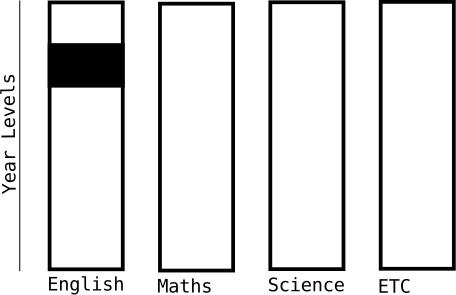
Figure 1. Subject and year level structure.
This creates a problem: the structure treats sequencing and time as the same thing. Some knowledge genuinely needs to be taught in order, because certain concepts depend on prerequisite knowledge. But much other knowledge has no natural order, therefore forcing it into year levels is arbitrary.
The result is artificial boxes. A Year 9 English teacher is confined to a narrow slice of content, even though the topics they teach and the aptitudes, interests and knowledge of the students in front of them often span multiple year levels and subject areas.
(D) Equivocal descriptions of content
A second reason curriculum documents fail to give adequate guidance is what Marzano et al. (2018) call equivocal descriptions of content. This is when a single content description bundles multiple distinct skills or concepts together into one statement. A teacher cannot tell which element is the focus, and there is no clear way to know whether a student has met the full standard or just part of it.
This problem is present in the Australian Curriculum. Consider this Year 7 English content description:
Use interaction skills when discussing and presenting ideas and information including evaluations of the features of spoken texts. (AC9E7LY02)
This single descriptor is doing several things at once: using interaction skills, discussing ideas, presenting ideas, presenting information, and evaluating the features of spoken texts. Each of these could reasonably be a learning goal in its own right. The descriptor gives a teacher very little guidance about where to focus, what to teach explicitly, or what meeting the standard actually looks like.
(E) Too much content, no prioritisation
A third problem is volume. Marzano et al. (2018) found that curriculum documents commonly contain more content than could realistically be taught well in the time available. The Australian Curriculum is no exception.
The deeper issue is that the curriculum treats all content as equal. There is no indication that some content descriptions are more important than others, or that some require significantly more teaching time. No content is flagged as essential, foundational, or optional. That judgement is left entirely to whoever is interpreting the curriculum.
This creates an impossible task. A teacher trying to cover everything risks covering nothing well. Without any guidance on what to prioritise, decisions about depth and emphasis are made inconsistently, varying from teacher to teacher and school to school.
(F) Optional content creates confusion
The Australian Curriculum includes elaborations alongside content descriptions. Elaborations are explicitly optional. They are examples of how a content description might be taught but is not a requirement. Yet they appear embedded within the curriculum document itself, alongside mandatory content.
This creates unnecessary confusion. Teachers reading the curriculum cannot always tell what they are required to teach and what is merely illustrative. If elaborations are optional, it is worth asking whether they belong in the curriculum document at all, or whether they would be better placed in separate teaching resources.
The same problem applies to organising ideas and indicators, which are woven into content descriptions in ways that blur the line between what is being asked and how it might be approached.
(G) Teaching one thing, assessing another
A more fundamental problem is the relationship between content descriptions and achievement standards.
In the Australian Curriculum, teachers are expected to teach the content descriptions but assess against the achievement standards. These are two different things, written in two different ways, serving two different purposes. This disconnect is rarely made explicit, and many teachers are unaware of it.
It raises a reasonable question: why not teach and assess against the same thing? If the content descriptions describe what students should learn, they should also be the basis for assessment. The current structure adds a layer of interpretation that makes the system harder to use and easier to misinterpret.
(H) No categorisation of knowledge type: declarative and procedural.
Marzano et al. (2018) distinguishes between two fundamental types of knowledge: declarative and procedural. Declarative knowledge is knowing that something is true — facts, concepts, generalisations. Procedural knowledge is knowing how to do something — skills, strategies, processes. These two types of knowledge are taught differently, practised differently, and assessed differently.
The Australian Curriculum makes no such distinction. Content descriptions are written without any indication of whether the knowledge involved is declarative or procedural. A teacher reading a content description must infer what kind of knowledge is involved and then decide how to teach and assess it accordingly.
These matters because the wrong approach leads to poor outcomes. Teaching a procedural skill as if it were declarative knowledge — for example, asking students to recall steps rather than practise them — does not produce the fluency that procedural knowledge requires. Without explicit categorisation in the curriculum, these decisions are left to individual teacher interpretations.
(I) Multiple versions through the adapt and adopt approach
Although there is a national curriculum, states and territories retain sovereign control over curriculum and schooling. This reflects their origins as separate British colonies; a position cemented at Federation in 1901 when education was left out of the Constitution entirely. Participation in the national curriculum remains voluntary and ACARA cannot compel states to adopt it.
The result, as shown in Figure 1, is that the Australian Curriculum is not delivered as a single unified thing. Each state, territory, and school sector adapts and adopts it differently, producing a range of divergent versions. Even jurisdictions that use the curriculum directly must still interpret and prioritise it. The Tasmanian Department of Education acknowledges this plainly: the full Australian Curriculum requires focus and prioritisation to make it manageable for teachers and meaningful for learners.
This creates a real problem for anyone trying to build shared resources. Textbook publishers, curriculum planning tools, and third-party providers cannot easily target a single curriculum because there is no single curriculum to target. A resource aligned to one jurisdiction's interpretation may not match another's, which means there are effectively no shared standards to build against.
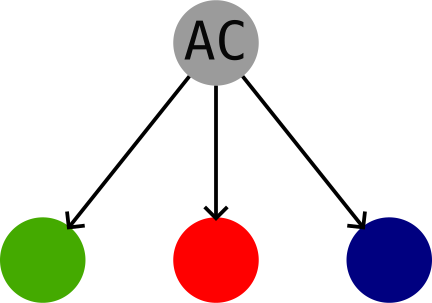
Figure 2: Curriculum fragmentation caused by the adapt and adopt model.
2: Not Enough Support
(A) Overall
The Grattan Institute, an independent think tank, has argued that governments have dramatically underestimated how much support teachers need to get curriculum planning right. Most teachers carry a heavy planning load and are too often left to manage in near-impossible circumstances (Grattan Institute, 2023).
The task of translating a curriculum into a coherent teaching and learning program is genuinely complex, and that complexity is consistently underappreciated.
(B) Not enough time or expertise
Curriculum planning is one task among many for teachers, and it is rarely given adequate time. Even when time is available, the task required carries a high level of expertise. It is very difficult to find someone who can do all the things required of a teacher as well as designing a curriculum.
(C) Tagging instead of designing
Marzano and others have noted a common workaround: rather than designing units from scratch using backwards design, teachers tag existing units loosely against curriculum requirements. If a unit has been taught before, it is far easier to map curriculum codes onto it than to rewrite it entirely.
The problem is that this gives historical units a kind of inertia. When the curriculum changes, as it did with Version 9.0, the units remain largely unchanged. Curriculum tags get updated but the underlying teaching does not. The curriculum becomes a labelling exercise rather than a genuine driver of what is taught.
(D) The wrong tools for the job
Most curriculum planning is done with shared folder systems and Word documents. The Tasmanian Department of Education's Systematic Curriculum Delivery framework, for example, proposes planning across four levels: whole school, year level, unit, and lesson. This structure makes sense — working at different levels of detail allows teachers to focus on the right things at each stage. But in practice these levels become four separate sets of documents, stored in four separate folders, with information duplicated across all of them by hand. When something changes, it needs to be updated in every document individually. Information drifts out of sync. Small changes become large administrative tasks.
Word documents make this worse. Word locks content and presentation together, so the same information cannot be shown in different ways without being rewritten from scratch. A year overview and a unit plan might contain much of the same information, but they exist as entirely separate documents. There is no connection between them.
Software developers have a name for this problem: Don't Repeat Yourself, or DRY. The principle states that every piece of knowledge should have a single, authoritative place in a system — update it once, and it is correct everywhere. Curriculum planning as it is currently practised violates this constantly. The same information lives in multiple places, maintained by hand, and kept in sync only through effort that could be spent on teaching.
Ideally, the different planning levels would not be separate documents but different views of the same underlying information. Change the name of a unit once and it updates at every level. That kind of connected planning is not possible with shared drives and Word documents.