Learning Now's Curriculum Planner
On the previous page, we explored the challenge of transforming Australian curriculum documents into teaching and learning programs.
On this page, we introduce Learning Now's curriculum planner and explain how it addresses that challenge.
Our approach is simple:
- Don't ignore the Australian Curriculum. The national curriculum exists to ensure every Australian student receives a consistent, equitable education. If we ignore the Australian Curriculum, then we undermine its goal.
- Work with what's there. The curriculum may have its limitations, but it remains the framework teachers are required to work within. Learning Now's curriculum planner works directly with it, without filters, buffers or interpretation in between.
- Provide clear feedback. The Australian Curriculum isn't perfect, and the best way to improve it is through constructive, specific feedback from the people using it.
What is curriculum planning?
Before we start, let's reiterate what curriculum planning is at its core: a transformation process. Curriculum documentation goes in, and a teaching and learning program comes out. Let me explain.
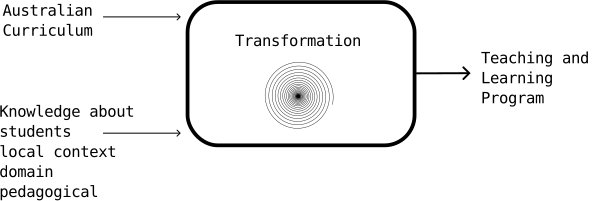
Figure 1. Curriculum -> Teaching and Learning Programs
As Figure 1 shows, curriculum documentation is the primary input, but the transformation also requires additional knowledge such as an understanding of the students being taught, the local context, the subject domain, and pedagogical approach.
What is Learning Now's Curriculum Planner?
Learning Now's curriculum planner guides you through a structured workflow to break down, organise, and understand the Australian Curriculum, so you can plan units with clarity and confidence. It is a cognitive tool that turns the overwhelming task of curriculum planning into a clear, step-by-step process.
A cognitive tool is opinionated. It reflects a view on what matters and in what order things should be done. It doesn't do the thinking for you. Instead, by structuring and directing your attention, it helps you think more clearly, more deeply, and more efficiently. It gives you the right tasks, the right tools, and the right focus, one thing at a time, so your attention goes where it matters most.
While the planner aims to produce excellent documentation, the true goal is for you to gain a deeper, well-connected understanding of the curriculum. Its three main goals are:
- Build a deeper understanding of the curriculum through the planning process itself.
- Produce clear, organised documentation you can reference with confidence.
- Provide a systematic way to give constructive feedback to ACARA.
Principles of this application
Learning Intention focus - Know where you are going before you plan how to get there. Effective teachers prioritise identifying outcomes and make learning intentions explicit above all else. (Lemov, 2010; Hattie, 2009, p. 206)
Backward design - Start with what you want students to know, then work backwards to plan. (Wiggins & McTighe, 2005)
Simplicity - Reduces cognitive load. If you are overloaded, you cannot process or act on information effectively. Focus on one thing at a time. (Sweller, 1988)
Feedback loop - The curriculum improves through feedback. This application helps you provide structured feedback to ACARA so the curriculum can be refined over time.